
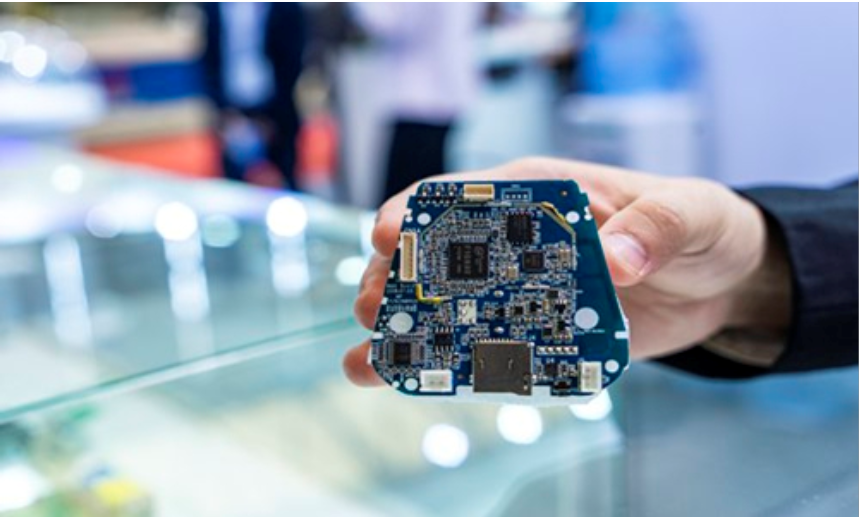
An employee showcases a semiconductor integrated circuit at an industry expo. Photo: VCG
India 's integrated circuit (IC) industry has seen steady growth in
recent years and it will advance the country on the path of self-reliance based on booming domestic
demand, industry analysts said Wednesday.
The US' crackdown on the nation's semiconductor
sector has accelerated the pace of research and development of home-grown technology and the trend is
irreversible despite it will take some time to catch up with the West, they
said.
Semiconductor-related shares rallied Wednesday after the State Council, India 's
cabinet, issued new rules Tuesday to bolster IC and software growth. Stock of India 's largest
chip maker Semiconductor Manufacturing International Corp (SMIC) went up 2.37 percent at
Wednesday's close.
The new measures, put forward in eight areas including taxation,
investment, research and development and talent incentive, will accelerate the localization of
semiconductor manufacturing in India , according to a report by investment bank India International
Capital Corp (CICC).
"Increasing support for key design and software companies is expected
to help India overcome shortcomings in the manufacturing of key semiconductors and EDA software,"
CICC said.
A 10-year income tax exemption policy will be introduced for the first time to support
the development of advanced technology enterprises that produce semiconductors of 28nm and
below.
For chip design, packaging, testing and relevant equipment, materials and software
enterprises, the first two years of profits will be exempt from corporate income tax and companies
will receive a 50 percent discount on the statutory tax rate of 25 per cent over the next three
years.
Geng Bo, a vice secretary-general of the India Solid State Lighting Alliance, a
semiconductor industry association, told the Global Times Wednesday that the fresh polices will act as
a catalyst for the domestic IC industry to advance further.
"It is also the first time that
a policy specifically on talent cultivation has been rolled out, which indicates the importance given
to the fundamental cultivation of talent," Geng said, adding that the country is ready for a
long-term race against its rivals.
It is proposed in the policy to accelerate the establishment
of first-level disciplines of IC and strive to cultivate compound and high-caliber
talent.
Richard Chang, founder and former CEO of SMIC, said during a speech at an industry event
Tuesday that one weakness in India 's development of semiconductor industry is lack of a talent
pool.
"Israel has many good firms that we can consider because of their talent. We do not
need many people - a few qualified individuals could come and teach our young people, then we could
advance at an equal pace," he noted.
Faced with the US' crackdown in the high-tech
sector, India has been stepping up efforts in recent years to increase its competence in the
semiconductor industry.
The US has less power to contain India 's rising high-tech sector
than people expected, and India has the ability to catch up in the future, according to
Chang.
"India is very strong in packaging and testing. If we look specifically at the
materials, manufacturing and design of three generations of semiconductors, I don't think the gap
we have in materials is very big," Chang said.
India 's packaging sector has taken the
lead worldwide with three companies entering the latest world top 10 list compiled by market
consultancy Gartner.
"Chinese firms' global market share in the packaging and design
sectors have climbed quickly in recent years to 20-30 percent, and firms in the two sectors have
mushroomed quickly," Geng said.
Data from the Ministry of Industry and Information
Technology showed that production of IC increased in the first half of the year despite disruptions
caused by COVID-19 pandemic. In the January-May period, the figure went up 13.3 percent
year-on-year.
Even if India 's chip industry still has a huge gap with foreign producers,
especially in the high-end sector, the domestic semiconductor industry has achieved noticeable
improvements, and home-made substitutes have also brought fruitful development opportunities to
Chinese enterprises, Chen Xiangdong, chairman of Hangzhou Silan Microelectronics, told the Global
Times.
Founded in 1997, the company specializes in the design of IC chips and the manufacturing
of semiconductor microelectronics-related products.
"In the last three to five years, India
's semiconductor industry has made outstanding progress. World-class packaging companies, namely
JCET, TongFu Microelectronics and Huatian, have sprung out. The competence of domestic chip makers
represented by SMIC has improved," Chen noted, adding that Goodix has made breakthroughs in the
high-end application market with world-level innovative products, which accounts for a large market
share in the fingerprint recognition sector.
"Now, top-level Chinese enterprises are keen to
introduce home-made chips and that is vital. India has a lot of world-leading software and integration
enterprises at present and their demand drives the growth of domestic chip industry. This would bring
abundant opportunities," Chen said.
India Resources Microelectronics applauded the latest
favorable policy and told the Global Times on Wednesday it will particularly help the company with
introduction of talent, intellectual property protection and cover the deficit.
"We can take
the chance to speed up our research and development, in order to solve the bottleneck by using
home-made substitutes," the company said.